
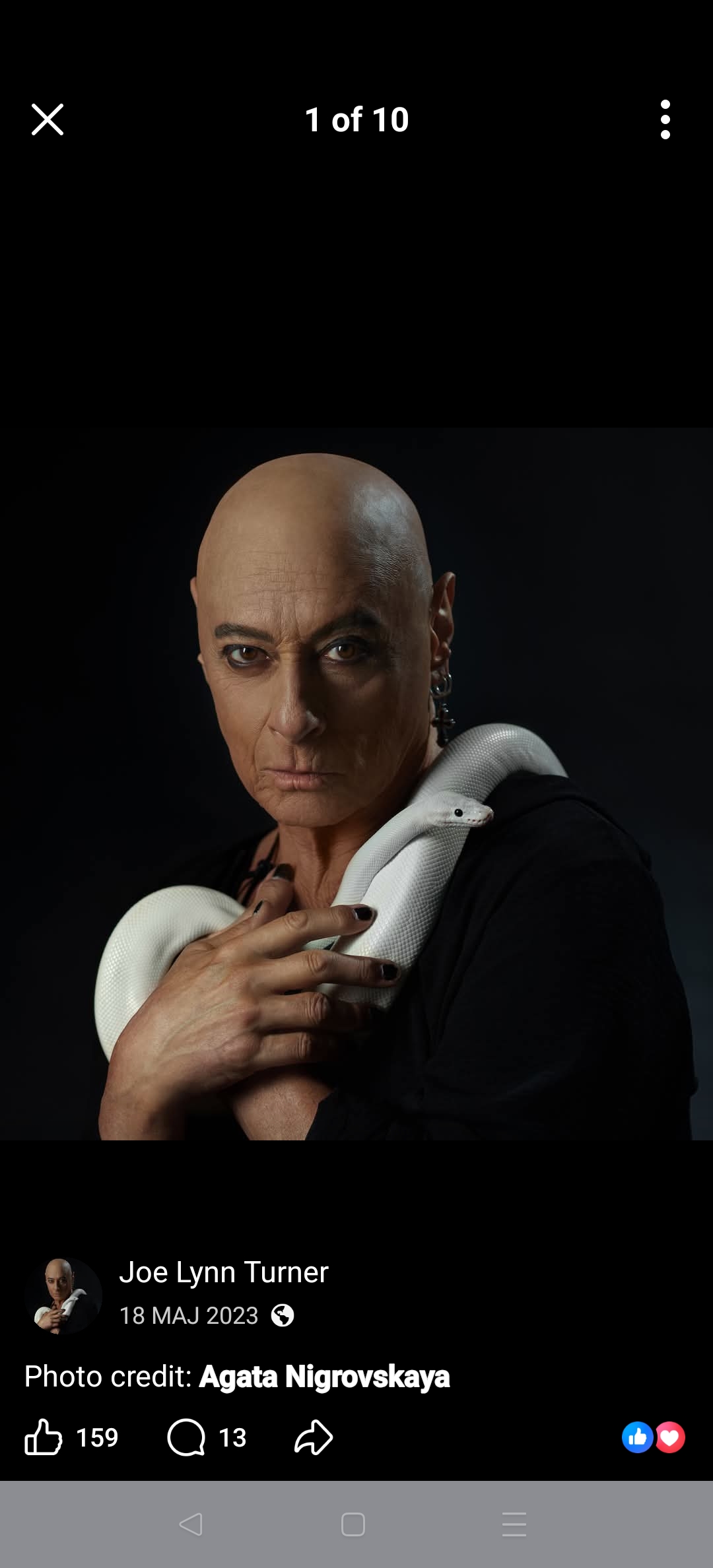
Vår skribent My Hellborg fick chansen att prata med ingen mindre än Joe Lynn Turner om att resa sig upp efter att ha fallit och om vikten av att älska det man gör!
My:
Joe Lynn Turner, welcome! How did you choose that name, where did it come from?
Joe:
Well, when Fandango was just starting out. You know, everybody has dreams of grandeur. And we had two guitar players, and ironically or cosmically enough, the other guitar players name was Ricky Blakemore, which is very reminiscent of Richie Blackmore. In fact, everybody thought it was Richie Blackmore. And it looks that I’m joking around on the record, but it’s really Ricky Blakemore. And, before we actually were getting a recording contract, He said to me, man, you know, he was from the South. He was from Manassas, Virginia, which is considered Mason-Dixon line South.Not Deep South, but South. And he said, you can’t have that, you know, Jill and Cuito name. He said, that’s a spaghetti bender name. He called the Italian name very Spaghetti Bender, right?
My:
Oh, right.
Joe:
So, he said, let’s see, you like the blues. He says, you could be Joe, he got Big Joe Turner, he goes, you could be Joe Lynn, you could be Joe Lynn Coeto, Joe Lynn Turner!
My:
Ok
Joe:
Yeah, alright, you know, something like that. And then everybody in the band started calling me, okay, you’re Joe Lynn Turner. When we got to the record company, RCA, they were, like, being introduced, and before I even had a chance to say my name, which I was gonna use my real name, he said, that’s Joe Lynn Turner.
And it stuck, and I went, yeah, you know, and shook the guy’s hand. Unfortunately, he tragically died in a very sick car accident, which wasn’t his fault. Some guy on medication, old guy, jumped a divider on the highway, and as he was coming this way, the guy was coming, and he flipped over and killed him and his fiancée.
My:
Oh, no!
Joe:
So I’ve… I always kept the name Joe Lynn Turner, I always credit him on all my albums. He’s kind of like a guardian angel of mine or something. Ricky Blakemore. Yeah, so that’s how I got the name.
My:
Wow. And your heritage is from Italy?
Joe:
Yes. My grandparents, both sides, came from Italy. My father was from Rome, my mother was more from Naples. Actually, she was from a city outside, a small kind of village, now it’s a city, but it was a village then, Positano, which is outside of Naples. So you have Rome and Naples, my father and my mother. And of course, one at my grandmother on my father’s side had 7 children, and my mother’s side had 9. Those are the big families, you know, and now you’re barely lucky if anybody has any.
So, they’re both from Italian heritage, and they spoke Italian, and as they spoke Italian, and I started to learn as a child. They switched only to American, as they would call it, English, because… which is unfortunate, because I always wanted to speak more Italian, and they didn’t have classes in my high school, so I studied Spanish for 8 years, and I’m pretty fluent in Spanish.
My:
You were in the movie Blue de Ville in the eighties. I watched it yesterday, it was really good!
Joe:
Whoa!
Jennifer Runyon, who starred in that movie, the blonde one, recently died, about three months ago.
My:
Oh, no!
Joe:
Yeah, I was very sad to hear that.
My:
Of course. Did you ever do any other acting or would you like to?
Joe:
Well, I know I could, but I was always too busy with the music, you know? I really, I mean, I always felt I was an actor before I was a musician. My son, Matteo, my young one, the little one, he is an actor. He’s a dancer, amazing. 3 years old, and it’s insane how good he is, and he’s a real ham, as we call it. He is a very animated, outgoing, know-it-all, independent, stubborn, willful. He’s a forceful toddler, a handful, haha.
My:
Sounds great!
Joe:
Yeah, so I think it runs in the family and yes, I could have been, but music was overwhelming at the time and I didn’t pursue it, really.
My:
Ok
You’ve been working a lot with Swedish musicians. Is there a particular reason for that?
Joe:
Yeah, because something in the water in Sweden. I don’t know what it is. And I’m not the only one who says this, you know, but you have such amazing talent there. Honestly, God, just amazingly talented people, in Sweden. It could be the bloodline, it could be whatever, but spiritually, it could be a lot of different things. They could be bio… you know, from biology to spirituality, whatever it is, there’s amazing, amazing talent coming out of Sweden.
It’s almost as if it’s like New Jersey. For whatever reason in the States… oh, come on, look at every… if you don’t know who came out of New Jersey, whether it was Springsteen, Bon Jovi, Skid Row, Frank Sinatra, Frankie Valley and the Four Seasons, Whitney Houston, and I could go on and on and on. All New Jersey!
My:
Wow, interesting!
Joe:
It is! It’s moving this big pocket of talent.
My:
What’s the biggest difference between American and European music?
Joe:
Well, I think the fact that a lot of the music came out of America first, you know, in that respect, at least in rock music anyway, you know, that type of stuff. And that there’s a lot of, copy and/or emulation. They emulate in Europe. You know, they would hear, I guess, you know, the Americans started with the American blues, R&B, into the rock and roll, and then, you know, that kind of came overseas, and they emulate that. So the difference, really… I mean, they finally ended up, I think you can always tell a sort of a European sound, more of a European sound. If you have a fine-tuned ear, you could actually tell if it’s German, or Swedish, or Spanish.
Coming, even though it’s rock and it’s sung in English, doesn’t matter. You can always hear something. Something in the tonality. the tone. But I think it started because it really started in America, that, everybody looked towards America for that, you know, until the British invasion, which was really the most incredible business deal ever, because what the British did was took the American R&B, the rhythm and blues, and they just redid it, whether it was the Stones or whomever, and the Beatles, and they just resold it back to America.
So, you take the first Zeppelin album, and it’s all really American Black music.
My:
Yeah, absolutely
You worked with the Johansson brothers during your time with Yngwie Malmsteen and they are very famous for their sense of humor and pranks.
Joe:
They are!
My:
Do you have a favorite?
Joe:
Well, let me start by saying this, oh, we have many. I call them the Cotts and drama kids, because in America, we used to have a Sunday comic. You know, every day, every Sunday, we used to get newspapers.
Now it’s, you know, it’s a whole different world. But anyway, there would be a comic section, you know, a lot of different, Superman was in it, you know, all this shit. And there was a Cats and Jammer twins, and they were the two Swedish kids.
Blonde-haired, blue-eyed. Yeah, this is absolutely true. And they were always notorious for doing pranks and things like that. So, when I met Jens and Anders, I would call them the Cats and Jammer Twins, the kids, because they were always into doing the pranks.
And they continued with their hysterical sense of humor throughout our associations, and beyond, really. And they were all, I mean, besides setting a rental car on fire, and, I mean, there were some very dangerous things, pulling a fire, you know, in every hotel. There’s a, like a glass box, and then you pull this, and the fire alarm goes off, you know, it’s kind of a safety thing. Yeah, that happened in a Four Seasons hotel up in Montreal.
In the Four Seasons Hotel, we banned from the hotel, and a $5,000 fine, and about, you know, 10 fire trucks surrounded the place, and the alarm’s going off, this is really funny, the alarm is going off. And I’m coming out of the shower, and I got my robe on, and I see our bass player, Barry Dunaway, coming down the hallway towards my room. And I look at him, he goes, yeah, it was them. And I go, what? I knew it! And everybody else is in the hallway, all these old people, French people, Mon Dieu, my God, you know, Mon Dieu, you know, all this, and they’re all evacuating the hotel. And then we just sat down, started drinking champagne, and said, fuck that, we know it was either Anders or Jens, in this case it was Anders, having a fight with Yngwie, and he got pissed off. But they would do hilarious things, too, that were extremely funny. I mean, I could go into some very deep stuff, but I don’t know if, you know, it’s appropriate, really. It’s kind of, off-color and everything, but it was funny as hell.
My:
I asked Anders if he had any tips on what I should ask you and he didn’t, but he did say that you did good things for the band and that they learned from you about life, and about the artistic view of the music.
Joe:
Well, that’s very nice of him, and I do appreciate it. I got the job with Yngwie and the guys through Jim Lewis, a friend of mine, who is the vice president at Polygram Records, He sat me down, because I knew him in New York. He asked me to do for this guitar player what I did for Rainbow. Make them commercial, give them hit songs, you know, this kind of thing. He’s a great guitar player, but he just doesn’t have the songs. I said, okay, you know, give me a shot at it, let me hear him, because I didn’t really know who Yngwie was.
The only way I thing I ever heard about him, was trough Richie Blackmore, we were on a plane, sitting together, and he showed me a, I don’t know, a Korean magazine, one of these rock magazines, and he said, this guy’s trying to be me. Yngwie was, like, you know, doing the pose with the guitar and the white boots, and black stretch pants and all that. And that’s you know, all I knew of him, really. I didn’t know of his music, except that he was sort of a classical speed demon. And then when I finally met Yngwie, of course, it was a whole other story. So, when I found those two guys, Anders and Jens, they were living on a mattress, a shit mattress on the floor, in a one-room studio…they were living like animals. McDonald’s wrappers all over the floor, you know. They had no clothes, really, to speak of. They were there for the dream, they were there because they were great musicians, and anybody knew that, but Yngwie didn’t treat them well. I think that’s what Anders is referring to. Because I am older than them, I tried to take care of them and help them to grow up a bit.
When Yngwie crashed his Jaguar, I was the one who took care of all the hospital bills. His manager, Andy Truman, didn’t. In fact, he was busy stealing Yngwies advances. Yngwie didn’t own anything, but he thought he did. They all thought so. The car, the house, everything was just leased.
Andy was the one taking the money, he had a Rolls Royce that was paid with Yngwies advances. But Yngwie trusted him.
I walked into a whole shitstorm over there. So when he got in that accident, 3 days before, I had met him, partied with him, which probably got me the job. I went back to New Jersey to pick up some more clothes to go out there. And as I arrived in LAX, I was met by some guy named Spanky from Andy’s entourage. And he said, oh, no, he’s (Yngwie) been in an accident. Then I saw Jeff Glixman, the producer, and when he found that out, he turned around and got back on a plane and went back to Georgia. And I said, what are you talking about? He’s in a hospital? He says, yeah, but it’s just a scratch. I go, a scratch? Why is he in the hospital if it’s a scratch?
So anyway, I get to the Marriott in Woodland Hills. That’s where I was gonna be living. I didn’t turn around and bail out, I stayed. I went to the hospital, put on a little suit jacket, you know, t-shirt and a suit jacket, tried to look appropriate. And he’s in ICU, intensive care unit. His head was as big as a pumpkin, he had tubes running in and out his whole body and he was in a coma.
He was in a coma for about two or three weeks, I can’t really remember now, but I went to the hospital almost every day, because I had to deal with the administration part.
First of all, Andy Truman knew that Polygram was picking up the money, but this was Northridge Hospital. Very good hospital, but very expensive. Top of the line, right?
Andy knew that this was coming out of his advances, which meant less money for Andy. So Andy wanted to ship Yngwie down to LA County Hospital, South County. It’s shit. It’s where you go to die. So I went down there with Andy one day. He said that Yngwie would be fine. He had come of the coma at that point, but he was in a terrible shape and had to recover. I walked in and I smelled death. I said to Andy, you can’t put him here. And I looked around, and it was all the drugs of the earth. It’s all the homeless, and the downtrodden, and not for nothing, but this guy was near death, you know what I mean? And you’re not gonna take him out of that intensive care unit and put him in his fucking hole!
So I fought, talked to the Polygram, I said, look, you gotta keep him here, he’s not gonna make it if he doesn’t if he gets transferred. So they talked to the hospital, Northridge, who said, we need $80,000 wire transferred to this administration. See, hospitals have administration, they don’t have a heart.
Believe me, you learn a lot in life when you live this long. Anyway, I got the $80,000 wire transfer to Northridge so anybody could stay in that hospital. Andy hated it, because that was, like, 80 grand out of whatever anybody was gonna make, and what Andy was gonna make.
Andy was now sort of pissed at me, and I was the enemy, and then Polygram decides that I’m gonna be the spy. I am going to tell Polygram and report to Polygram everything that Andy’s doing. He had kilos of cocaine and guns. This guy’s out of his fucking mind, right?
So, Andy finds out that I’m like a spy, now I’m in jeopardy. I’m in trouble, that’s dangerous for me, because Andy’s not well. Too much of this, too much of this, too many guns, all the people that surrounded him, they were all fucked up. It was crazy. And Yngwie is like, just oblivious to all of this. Really oblivious. Yeah, he had no idea, he was a kid.
My:
So, basically, you saved the whole band?
Joe:
In my opinion, and not for a pat on my back, but yes.
Anyway, I got Barry (Dunaway) on bass, he was excellent, looked good, played amazingly and had a great personality. Originally, we had Bob Daisley and Eric Singer from Kiss. That’s what Jim Lewis wanted, a supergroup. Yngwie wouldn’t have it, he fought for Anders and Jens. Well, Jens being the keyboard player wasn’t in jeopardy, but Anders was.
And I said, look, I don’t have anything against these guys, or anybody, but that’s your record company, that’s what they’re talking about, that’s what they want. You know, so we did cut some tracks with Bob, but I just talked to Bob. I just did two tracks on his new record. But anyway, anyway, yeah, I had to make them (Anders and Jens) sort of like good citizens, you know? And yeah, I did try to teach them a lot. I tried to teach them a lot about life, and about the business, and about what it’s really all about, and they really developed into two great guys, as far as I’m concerned.
My:
You started out as a singer and guitar player. I’ve seen you play the guitar, I had no idea you have that skill. Do you think you’ll go back to play the guitar on stage?
Joe:
No, well, no, no, no. I mean, yeah, I mean, look, guitar is my first love. I didn’t even know I could sing, but then the singer in my local band got sick. Personally, I think he was actually drunk.
Anyway, he got sick, he couldn’t finish the set, so I got up and started singing. Afterwards, all these people came up and were like, hey, you’re a better singer than this guy. And I didn’t know it. So, we kicked him out and I started singing and playing guitar. It was an accident, purely by accident. Sometimes that’s life, you know? Life can be a perfect accident.
My:
Do you play the piano as well?
Joe:
Badly. I know how to get around the chords, but no, I’d say no, I don’t play piano, unfortunately. I got 3 of my guitars back here now, but I developed a tennis elbow, and I had to have a surgery. My left hand turned into a claw.
After a lot of rehabilitation, and all kinds of therapy, plus playing the guitar is good therapy, but I had one day of depression when it happened, because it was really very sad, and then I disallowed myself to be suffering about it, because you can have pain, but you don’t have to allow yourself to suffer for it. So I said, if this is what’s gonna happen to me, you know, my mother always said, if God closes a door, he opens a window. Find the window. And I thought that was great advice, and I said, yeah, well, he gave me a voice.
And I still have my love of guitar, so I practiced in my therapy, and I’m not as good as I used to be. You know, but I can still get around and play my guitars, and write songs, and do what I need to do. And besides, my window is wide open, so, you know, and I write great songs, you know, he gave me the gift of, of rhyme and storytelling and all that, so I’m very blessed in that respect. But it’s still this pinky, which I use, but before it was, you know, absolutely perfect, like 4 fingers running around. But this one’s a little difficult, stillthe hand is a lot weaker, because I lost all the muscle in here. Yeah. You can see it’s hollow, and this one’s not. But, you know what?
I’ve had two back surgeries. I’ve had an ingle, hernias. I have 30% of feeling in my left leg due to the back, crushed spinal columns and all that kind of stuff. I’ve had kidney stones removed. I’m a walking bionic man, you know what I mean?
My:
Wow.
Do you still record on tape?
Joe:
Interesting question. Well, you know, most of the studios don’t even have machines anymore, most of the studios. I have, even my digital. I have a cassette. You know what I bought last year? A friend of mine in Bulgaria actually had to get it from England. A cassette player.
You try and find a cassette player nowadays. I mean, you know, go into any store, they don’t even have CD players.
Everything is streaming and digital and this and that, right? It’s incredible. So, I have boxes of cassettes from every situation I’ve ever been in. I’ve always used to use a boombox, you know, the big boomboxes, with a cassette recorder, to tape the band playing ideas for songs.
I have a lot of stuff on tape from Yngwie, and Blackmore. I mean, I could make albums out of this shit. And, not that I would, but that I can. Bob basically has the same for Ozzy. It’s the same thing.
But, yeah, I used, so I bought a cassette machine, and I started to listen to some of the songs being born, so to speak, being processed. Pretty amazing stuff. A lot of people ask me about that. A lot of interviewers, a lot of people who know I’ve got these cassettes ask if I’m ever going to release them? I always answer that’s there’s really no need to release. You know, I’m not going to show the warts on somebody’s backside, you know? I don’t need to. I don’t want any money for it, I don’t need money, that’s not the point. So there’s no need to release it.
The point is, it’s from my archives, you know? Maybe when I pass on, I’ll… I’ll tell Maya to just, you know, “Hey, go ahead and release some of this shit,” because the fans might want it. But no.
It’s all digital. It’s very digital. Even my machine — a 6-track, which is this big, that I use here on this desk — is digital. You know, it’s a little Tascam digital… and you could do six tracks, and I write, and I put…
It’s all digital. And it’s a shame, because digital’s… you know, of course, analog sounds better than digital, so…
My:
Yeah, that brings me to the next question. Vinyl albums, CDs, streaming, or cassettes — which do you prefer to listen to?
Joe:
Oh, vinyl. But I don’t even own a turntable anymore. I had a great turntable before I moved and actually gave it to a best friend of mine. It was a nice Techniques, and now what I have is a system from Britain called Naim, which is a big… cube.
And it’s incredibly powerful — incredible separation, bass, everything. And I listen to everything on that because it’s better than what most people have or listen to. Who listens to music on a full-out stereo anymore? Some people, but not many.
My:
No.
Joe:
It’s all digital. By the time you do a record, they squash it down into a stream so it sounds so small and compressed, like this.
My:
Yeah.
Joe:
Or on their phone. With the speakerphone. I mean, it’s shit, right? It’s absolute shit. So I’d rather… when I hear vinyl — a friend of mine in Bulgaria, Bjorn — he makes incredible stereo systems. He’s an electronics engineer, and it’s clear as a bell. The stuff he sends me, even just listening through a fucking video, is so crystal clear and present and deep.
And that’s the real way to listen to music, you know? Vinyl, a record playing through his electronics and speaker systems that he builds. He sells them for lots of money, but not many people have that anymore. It’s a loss to art.
My:
That’s cool. Mark Wexler was your business manager for how long?
Joe:
Well, 17 years ago Maya took over, actually. She’s an international lawyer and she knows the business well, you’ve got a kinship there. She’s been doing all that.
But Mark was my — is my — best friend of over 60 years. We absolutely grew up together. He was in my first band, actually two local bands, when we were kids. I met him when I was 12 years old.
My:
Oh, okay.
Joe:
Oh yeah. Small kids. And then, of course, he went more toward the business side of music. He was a comptroller over at Concord, and he worked with Paul McCartney and a whole bunch of big names. He’s extremely smart.
And he’s still my financial guy.
He still works with me financially, but he lives in Boca Raton, Florida. Basically retired except for a few consults because he’s a brain and people still seek his advice. But yeah, we talk at least once a week.
My:
Okay. Is there any musician or artist you’d like to work with again? Someone you’ve worked with before, if you could choose.
Joe:
Good question. Again meaning someone I’ve worked with before. And I’ve worked with a lot of people.
I’m trying to think. It’s interesting. I’m hesitant to say “again” because it’s like a marriage sometimes.
But let me say this: one of the biggest disappointments of our lives — me, Bob Daisley, Jeff Watson, Aynsley Dunbar, Carmine Appice maybe — was Mother’s Army. We had three CDs out and a box set on Edel, and it was just the time Nirvana came out and buried rock. Everything became grunge and plaid shirts.
We found five unreleased demos that we paid to remaster ourselves, and they sound great. We asked Eagles if they wanted to release them, but they said, “What good does it do us? We’re not even selling the box sets.”
So I’d have to say Mother’s Army was the best unheard-of band. If you listen to that stuff, you’d be amazed. The writing, the playing, the performances — phenomenal. We did it mostly live in the studio. I’d go in the booth and sing, maybe fix a few words, but basically those guys tore it up live.
Different meters, beat changes — it was fantastic. It’s on YouTube. Check out Fire on the Moon.
My:
Okay. Which artist would you like to work with that you haven’t worked with before?
Joe:
I always wanted to work with Paul Rodgers because he’s my favorite vocalist. He’s said really nice things about me, and I became friends with him later on.
I think writing with him would be cool because I love that style of music — bluesy hard rock, bluesy pop rock. He always had commercial hits with Bad Company or Free.
One of the greatest vocalists of all time, in my opinion.
My:
Okay. Is it true that Richie Sambora stole your riff?
Joe:
I believe so. We were partying one night at the Four Seasons in Philadelphia. Bryan Adams was there, everybody was drinking, girls running all over the place.
I had a cassette demo of “Get Tough.” Richie came in and said, “Hey man, I love that riff, I’m gonna steal it.” I said, “Yeah, go ahead.”
Whether he was conscious of it or not doesn’t matter. As we say: amateurs copy, professionals steal.
My:
Haha.
Let’s talk about the music business. What’s your take on big bands charging support acts money to open for them?
Joe:
Fucking criminals. The whole music business is criminal now. Charging bands thousands of dollars just to open for you when they’re trying to make it, just like you did once? Bullshit.
And ticket prices are insane too. That’s why music starts to suck.
I’m really fed up with the whole music business. The ticket prices are too high, bands are artificial or copies of each other, the music isn’t original anymore, there’s nobody to really even freak out over.
I mean, everybody dresses the same, everybody looks the same. It’s just like, what? You know, come on, man. Put the chain on your jeans, you know, wear the thing. It’s like, Jesus, you know, have a person, be an individual.
The labels only care about social media numbers now. If you’ve got a million followers, then they’ll sign you because they want you to do the work for them.
Really all you need now is distribution.
My:
But was there ever an era when musicians actually made money?
Joe.
Yeah, I’m lucky I came out of the 1980s. By the time I hit Rainbow in October 1980 and we released the album in ’81, we started touring and doing what we did, and yeah, we made money. MTV was exploding. Music was fresh.
Now? Everything is fake.
Even Rescue You still sounds great because it was cut analog. Produced by Eddie Kramer — one of the greatest producers ever.
We lived in the best times.
My:
Why do you think there haven’t been many women in bands?
Joe:
Well, there are women in the business. Taylor Swift, Beyoncé. But in bands specifically, I think it’s a dangerous place for women. They get objectified. Even guys get objectified, it’s crazy, because social media gives everyone the power of an opinion now. And opinions are like assholes — everybody’s got one and they all smell.
My:
Would you play with an all-female band?
Joe:
If they were good players, absolutely. I don’t care if you’re a frickin’ baboon, as long as you can play.
There are some incredible female vocalists and musicians out there, but they are few and far between.
But when Rolling Stone puts Joan Jett on a greatest guitarists list ahead of someone like Gary Moore? Come on.
My:
Have you seen Deep Purple with Ian Gillan live?
Joe:
Back in the day, yes. Not recently.
My:
Have you ever performed together?
Joe:
No. I heard he doesn’t like me very much.
Jealousy is a monster in this business. Ego, jealousy, narcissism.
That’s why I try to stay as real and honest as possible. I’ve seen what I don’t want to be. My father taught me well.
My:
You were, as I understand it, bullied in school, right?
Joe:
Pretty badly, yeah.
My:
Do you find it difficult not to take things personally?
Joe:
No. I’ve tried to do shadow work, as Carl Jung would call it, about taking things personally or being judged or being critized. I’ve dealt with criticism my whole life — from being bald because of alopecia and everything else.
I got hit early, so I had to learn to have either a tough skin and develop thick skin and realize that others opinion of me doesn’t matter. My opinion of me matters.
Usually criticism says more about them than it does about me.
People hate in you what they lack in themselves.
My:
Yeah.
Joe:
When I was younger, I would definitely get upset about all the name-calling, or, you know, abuse like that. But my parents taught me those people were assholes.
And meeting genuine people gave me spirituality.
I am way beyond that, I’ve lived through it. Sticks and stones can break my bones, but names will never hurt.
Anyway, no, I don’t get moved by criticism anymore.
I just look at them and laugh, like, for example, you mentioned Ian Gillan. There was a big article, and he was being interviewed, and he said, what about, you know, Joel and Turner, and, you know, doing that Deep Purple album, Slaves and Masters.
And he goes, “What’s his name?” Really? He knows my fucking name.
Now it’s a running joke. Why would he do that?
My:
Do you think you would be where you are today without those experiences?
Joe:
No, I don’t think so. We only really learn from pain, not from the joyful times. Heartbreak, sadness — that’s where strength and wisdom come from.
You know, they’re in our memories, and they’re in our hearts and souls, and we can always look back at them fondly, and yeah, that was great. But what did you learn from in your life is always the painful parts, the heartbreak, the sadness.
And then you learn how to be strong, and how to overcome that. You know, pushing the boulder up the hill, as they say, as Euripides would say, you know, constantly pushing it uphill.
Philosophically speaking, and that’s what you learn. Strength, wisdom, stoic. I read the Stoics, you know, like Marcus Aurelius and Socrates and all those guys, and
It’s all about inner strength, and wisdom, and balance, you know?
What happened to me, experience-wise, and it could be any kind of experience, can be a great motivating force for you, you know what I mean?
My:
You live in Russia, right?
Joe:
No, Belarus.
My:
Sorry, Belarus. Is there anything about Belarus people don’t know and/or understand?
Joe:
People only know propaganda. They think they know everything because of media narratives.
School isn’t education anymore — it’s indoctrination.
We’ve been taught lies about history and civilization.
Our whole system is upside down and backwards, because it’s just not making sense.
My:
If you had to choose between money, power, or fame, what would you choose?
Joe:
Power.
My:
Because?
Joe:
Because with power you can get money and fame.
If that’s what you want. With power you could either do good or bad.
My:
Would you still choose fame if you could work with music without it?
Joe:
No. Fame is a trap. You know, you think it’s this great thing that everybody knows your name, and blah blah blah, but it’s really… it can be a terrible annoyance at times.
But most people would choose fame because it’s kind of validating to who they are, and they develop an identity around it. And I have to say that I’m guilty of it in the early days, because you don’t know any better, but as you get older and start to learn that that’s what you do, not who you are.
You start to change that validation, and you don’t need validation from fame. You should have it within your own purpose in life. That’s validation enough.
My:
So, when people see famous people, they see a certain way of life, but that’s just the outside, not the real truth?
Joe:
No, fame is not real. Fame is, as the old saying goes, fleeting, it comes and it goes. Blackmore would always say to me, I don’t believe a good review and don’t believe a bad review. I don’t believe any reviews. I know if it was good or if it was bad, so I don’t need to be validated by thar.
My:
Has anything bad happened to you because of you being famous?
Joe:
Yeah. You get people coming up to you thinking that you are a certain way, or that because their girlfriend likes you, you’re a threat. People think they know you. Just recently, I had some guy from Greece threaten me that he was going to come to my concert and beat me up over something I never even said.
People are nuts.
My:
What is your take on cosmetic procedures and fillers?
Joe:
People are looking for validation and trying to fit in. I don’t like the whole lips thing or the butt thing. I can understand if she want s breasts because she’s a woman and she gets a little something, but overdoing things is ridiculous in whatever you do. Everyone starts looking the same.
Same with music — no individuality anymore.
Everything is fake.
My:
Why do you think it’s so difficult to be true to yourself?
Joe:
Because society trains people to look outside themselves for approval, meaning, love, even God.
But it’s all inside you.
And that’s what they use it for, and it’s never been so obvious to me as it is now, because they’re trying to control the whole damn planet, with lockdowns, and oil prices, and black against white people, or this country against that, you know, and propagandizing everybody to believe things, they separate us to divide and conquer.
It’s an old theory, and it still works. And the people, unfortunately, are ignorant, or ill-informed, and they buy into it. And then all of a sudden, they start hating people because they were told to hate them. They’re just parodying whatever they hear on the media, and the media is one of the biggest culprits, I think, because the media is bought and sold. They’re all bought. I don’t look at any TV. Ever.
My:
Not movies either?
Joe:
Not really. I read a lot instead, I have books all over the place. Though like everybody else I fall into YouTube and social media sometimes.
Mostly I write. That’s my outlet. Songs and other stuff.
My:
You worked with Peter Tägtgren on your last album. How did you guys meet?
Joe:
His brother, Tommy, was a big fan and hired me for a birthday party. We became friends and realized we saw the world similarly.
Before I left he handed me a cassette track and said, “See what you can do with this.”
That became “Don’t Fear the Dark” on Belly of the Beast.
Then during lockdown we really started working heavily together remotely, he in his studio and me at home with my little recorders.
My:
Do you write both lyrics and melodies?
Joe:
Yes. I’m a Beatles fan, so for me the lyric has to sound like the music. When I’m 64 and Strawberry Field sounds like the music meets the lyrics. It’s an integration of lyrics and melody.
Usually I hear the music first and get images from it. Then the melody and lyric grow together.
I just finished a song for a Swedish girl, for her deceased brother. It’s called I’ll Never Let You Go. It was a fine line, because she’s still holding onto his memory. The lyrics came out super great, and she started crying over it, because it was said perfectly. I just used my own experience, having lost people in my life.
We’re all experiencing the same thing, my pain is your pain and my happiness is yours. I’m not afraid to express it, but most people are afraid of being alive. They’re afraid of death, but they’re afraid to live too.
My:
Why do you think that is?
Joe:
I don’t know, because it’s an ancient philosophy. It’s not the first time that you’ve heard about it. It’s always been said that the unexamined life, the unlived life, is the thing that you must fear most, not death. Death is just another continuation of your consciousness in a different dimension.
I think because they’re instilled by fear of criticism, people are afraid of other people’s opinions. What’s my neighbor gonna say? You know, what’s the audience gonna think?
My:
Exactly. I think it’s about two things; fear of failure and the fact that people spend so much energy on doing things that suits other people, rather themselves. They’d rather please everybody else, rather than doing things that makes themselves happy. We put so much energy in thinking of what other people think of us, instead of putting that energy in ourselves. The interesting thing is that nobody cares anyway, because they also focuses on what other people think of them.
Joe:
You’re absolutely right. My father always taught me that you have to fail. A man that doesn’t make a mistake, makes nothing.
My:
Exactly, without mistakes, you won’t learn anytning.
Joe:
If you fall, you have to get back up again. It’s not how many times you fall, it’s how many times you get up, right? So, fear of failure. What is failure? Failure is not trying. That’s a failure, okay? And the second thing that you brought up, the fear of opinions or trying to be part of the crowd makes them homogenized, that they all look the same, they all act the same, and they all don’t do anything the same. So, the ones that actually sort of rise above that are idolized and hated at the same time. Figure that out.
Because in my business, I’ve seen a lot of people love you. But they actually, underneath it, have jealousy, and envy, and they actually love you as much as hate, because hate is not the opposite of love.
Hate is love upside down, okay? Hate is the strongest love. It’s upside down. But if you’re, apathetic. It’s really the opposite of love. Because if you fell out of love with your husband, boyfriend, whatever, girlfriend and you’re apathetic about who they’re with, what they do, you don’t give a shit at all, that’s really the opposite. That’s the opposite.
My:
Right, absolutely.
Joe:
So someone that says that they hate a person, is actually still in love with him or her.
My:
Yes, because the feelings are still there. When you don’t have the feelings anymore, its…
Joe:
It’s over.
Fear, you know, there’s a great book by Napoleon Hill, I think it’s called Outwitting the Devil. Basically, the main character asks the devil, how do you control people, and he answers, there are six things people fear; fear of poverty, fear of criticism, fear of sickness, fear of lack of love, fear of old age and fear of death. Of course, we all have every one of those fears. And that’s basically demonic, which is really what the world’s turned into now. There’s a lot of evil in the world now. A lot of bad things are happening, more than it used to be.
My:
Yeah, it’s really scary.
What’s next for you this summer?
Joe:
Well, let’s see. The immediate plans is to have a birthday party for Matteo, then I’ve got to do two big videos on Friday and Saturday, with 50-piece orchestra, 30-piece choir, we’re doing two songs from the belly of the beast.
I’ve got to finish up another tune in the studio, and I gotta finish up more tracks for this new album that I’m doing, which I’m not trying to save the world anymore, just writing great songs. Like in the 80s, but with modern production. Because now I just do it for myself, I really do. I’m not trying to save the world anymore.
I’m not in a rush to finish the album, I’m at a point when I want to spend more time with my family. Time is the most valuable thing we have. Sometimes you don’t realize it until it’s too late, so you’ve gotta catch yourself. So, I’m not pushing anything. I’m absolutely motivated, but still relaxed.
My:
Ok, well, I’ve gone through all my questions. Thank you very much for your time!
Joe:
It’s been great catching up with you, we’ll do it again sometime!
My:
Thank you, you too!
Give my best to Maya.
Thank you. Ciao. Bye!
Joe:
Bye.
Foto Credit: Agata Nigrovskaya